Introduction
When studying biotechnology and its applications, it is important to understand the structures of not only microorganisms, but also multicellular plants and animals, as these organisms are mostly targeted by selective breeding. For this reason, this chapter reviews the structures of plants and animals.
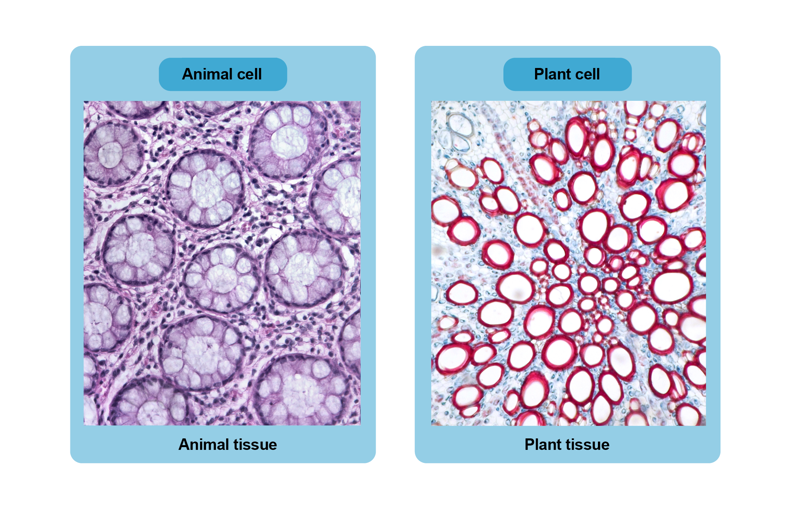
All the cells of a multicellular organism originate from a single fertilised egg cell or ovum, which then divides to form all the other cells.
As the human embryo develops, its cells differentiate and join together to form larger structures. These structures are called tissues[term: tissue – A group of eukaryotic cells that are similar in structure and function. For example, muscle tissue in animals or vascular tissue in plants.].
Plant cells and tissues
Vascular plants[term: vascular plants – Plants that have vascular tissue specialised for transporting substances. These include ferns and seed plants.] consist of a root and a shoot, the latter of which are divided into a stem and leaves. The flowers of flowering plants are modified leaves.
Every part of a plant contains cells that have evolved to perform specific functions. Some of these cells are responsible for photosynthesis, producing the organic compounds necessary for the plant’s growth and reproduction.
Some cells have evolved to specialise in transporting substances, while others have evolved to specialise in functions such as nutrient uptake and reproduction.
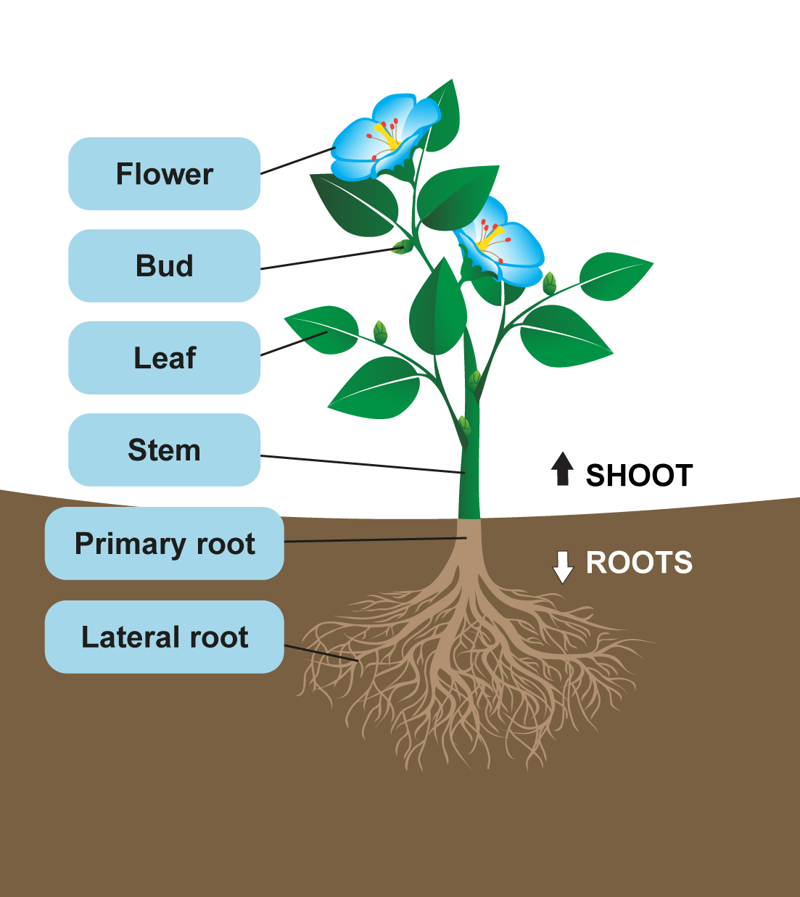
The tissues of a plant can be divided into meristematic tissue and permanent tissue.
The permanent tissue of a plant includes parenchymal, dermal, vascular, sclerenchymal and secretory tissue.
Almost all parts of a plant contain relatively undifferentiated parenchyma[term: parenchyma – Plant cells that do not divide. These cells come in various shapes and make up most of a plant’s tissues. Examples include photosynthetic parenchyma cells and storage cells.]. For example, photosynthetic tissue and many storage tissues are examples of parenchymal tissue.
The function of dermal tissue[term: dermal tissue – Cells that protect and separate the plant from its environment. For example, the epidermis of a leaf.], also known as surface tissue, is to isolate the plant from its environment. In addition to providing this isolation, it prevents water and other essential substances from leaking into the environment.
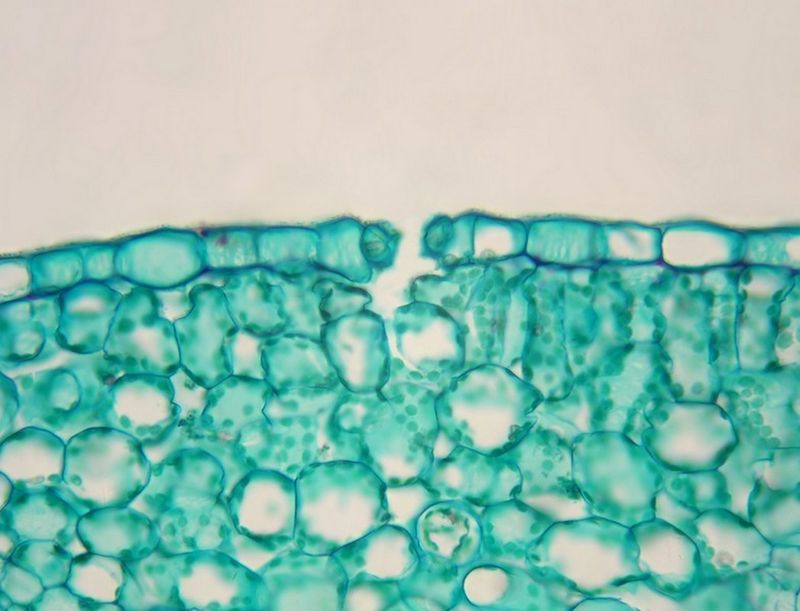
Dermal cells are found in almost every part of a plant. In leaves, they slow down water evaporation and facilitate gas exchange. In stems, they provide protection for the cells under them. In roots, they protect against mechanical wear and tear and help to absorb nutrients.
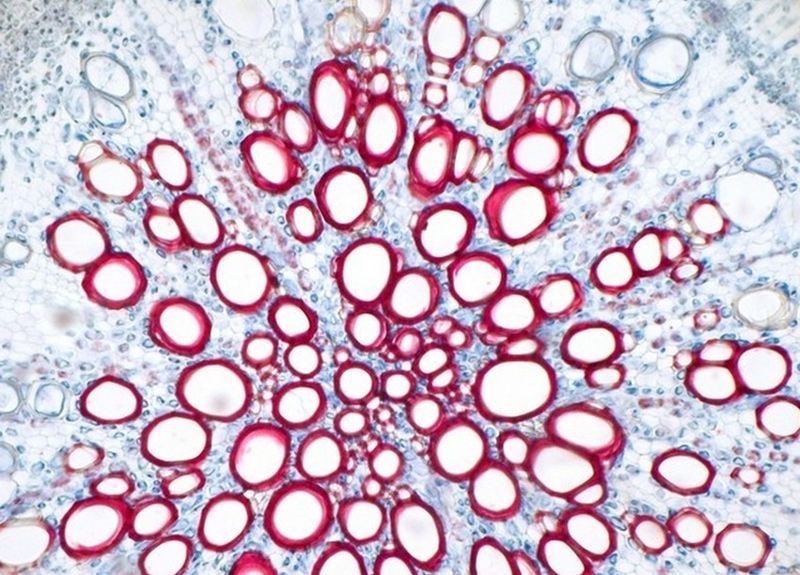
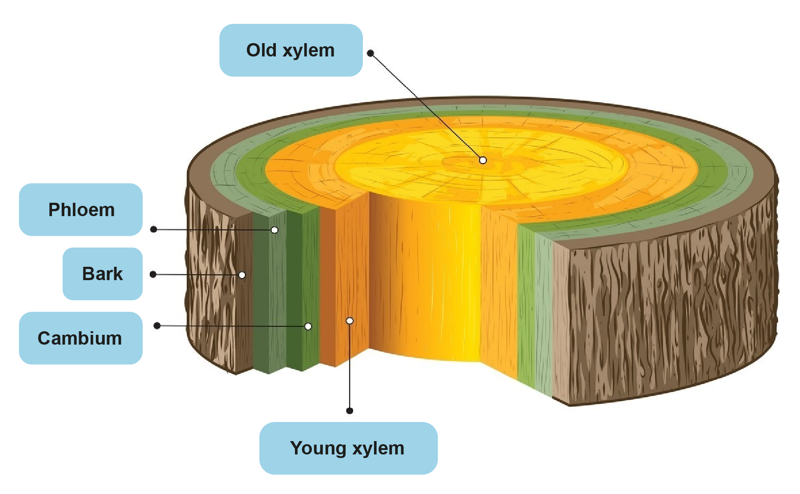
Vascular tissue[term: vascular tissue – Plant tissues that transport substances within the plant. The xylem transports water to the leaves and the phloem transports the products of photosynthesis.] is found in the plant’s stem, roots and leaves. Its function is to transport water and nutrients to photosynthetic cells, and to carry photosynthetic products back to the roots and storage tissues.
The vascular system is divided into the phloem, which transports photosynthetic products, and the xylem, which transports water and nutrients. The phloem is living tissue, whereas the xylem consists of dead cells whose cell walls are thicker than those of the phloem cells.
The function of a plant’s sclerenchyma[term: sclerenchyma or supporting tissue – A type of plant tissue that provides structural support to the plant. It is divided into two types: thin-walled collenchyma and thicker-walled sclerenchyma.] or supporting tissue is to protect its vital parts and support its structure. In addition to the stem and roots, sclerenchyma is found around seeds, for example.
The plant's secretory tissue[term: secretory tissue – Cells that produce secretions inside or on the surface of a plant.] secretes substances that may be needed to repel pests or attract pollinators, such as nectar. Many strongly scented oils produced by plants, such as lavender oil, are products of secretory cells whose function is to repel pests.

Plant tissues and function
The basic structure of vascular plants comprises roots, stems and leaves. In more primitive plants, such as mosses, these parts cannot be distinguished. For this reason, they are known as thallophytes[term: thallophytes – Plants that do not have easily distinguishable parts, such as leaves, stem and root. Examples include algae and mosses.].
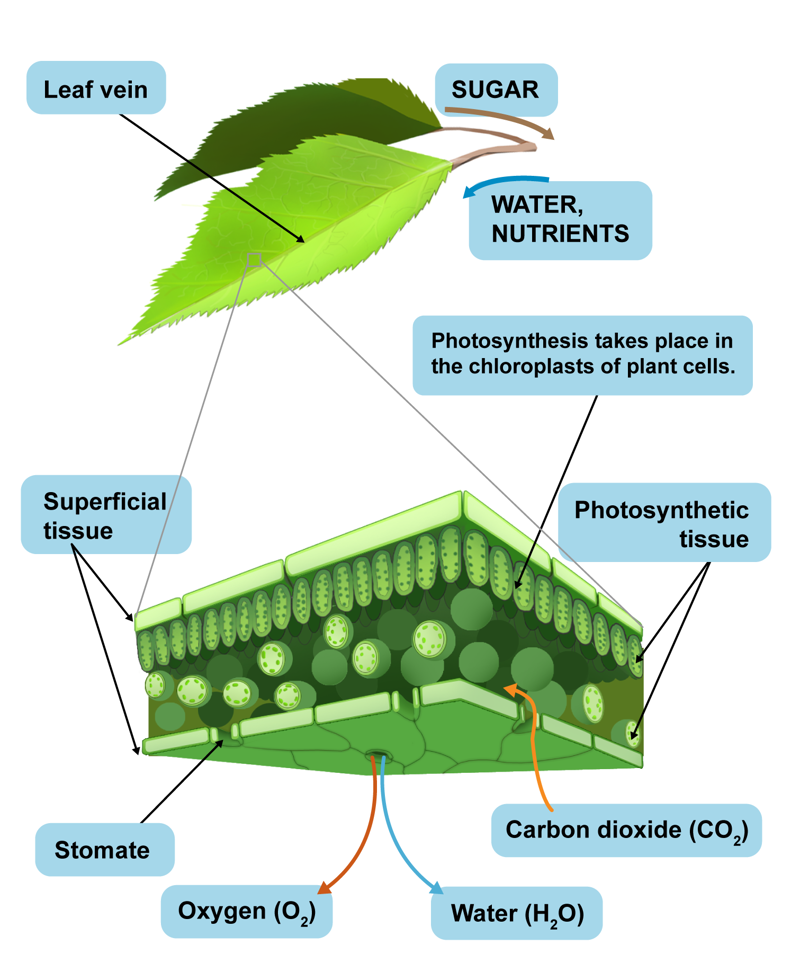
Plants produce energy in their leaves using photosynthesis[term: photosynthesis – An energy production process powered by sunlight in which sugar is produced from carbon dioxide and water, while oxygen is released. This process occurs in green plants and certain bacteria, among others.]. In this process, solar light energy, water and carbon dioxide are converted into chemical energy stored in organic compounds, such as sugars.
Photosynthetic cells do not require all of the compounds that they produce; some of these are stored in the plant’s fruit, while others are transported to cells in the roots.
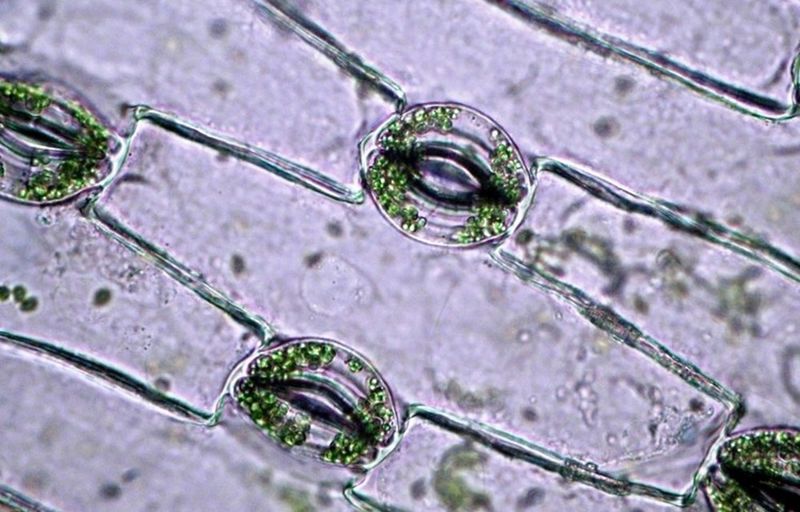
The leaf's surface is protected by a layer of epidermal cells. The gas exchange inside the leaf is regulated by structures called stomata, whose guard cells[term: guard cells – Specialized cells formed from the epidermal layer of a plant leaf that regulate the opening of the stomata. Gases are exchanged through these stomata.] open and close as required. When the guard cells open, a gap is formed between them, enabling carbon dioxide from the atmosphere to enter the leaf. At the same time, water vapour and oxygen, which are released during photosynthesis, can escape into the environment. The opening and closing of the stomata are regulated by the leaf’s water status. When there is enough water in the leaves, the guard cells swell and the stomata open.
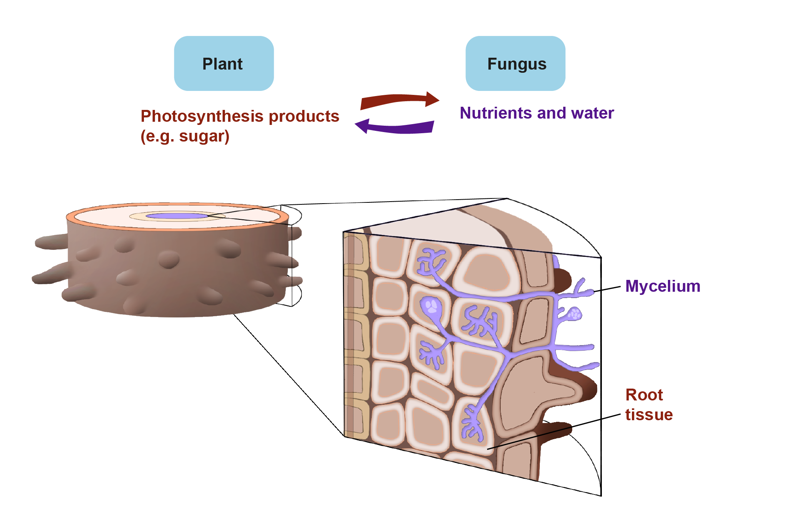
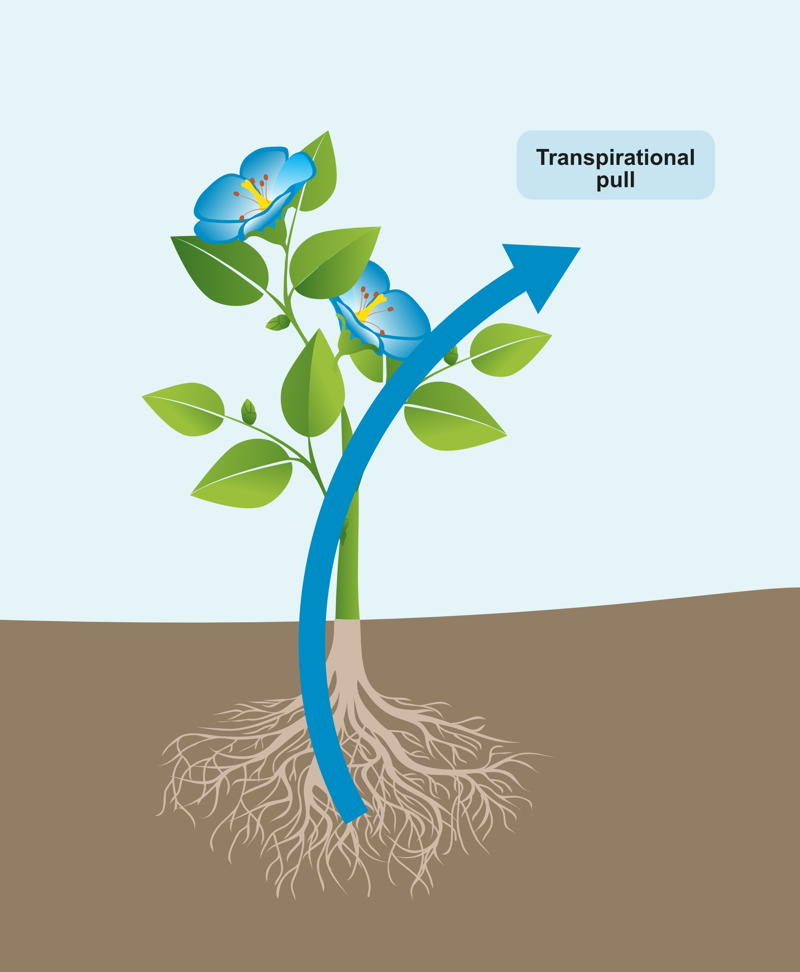
Plants obtain the water and nutrients they need for photosynthesis through their roots. The surface of root cells may have small root hairs which enhance the uptake of water and nutrients. Plants can also form a mutually beneficial relationship with fungi by forming a mycorrhiza[term: mycorrhiza – A type of symbiotic structure between a plant and a fungus. The plant provides the fungus with photosynthetic products, and in return, the fungus provides the plant with nutrients and water.]. The mycorrhiza helps the plant to absorb water and nutrients, while the fungus benefits by receiving some of the plant’s photosynthetic products.
Water and nutrients absorbed by the roots are transported through the vascular tissue of the plant stem. This process is aided by the continuous evaporation of water through the stomata in the leaves.
The plant's stomata must be open in order for it to obtain the carbon dioxide necessary for photosynthesis. The continuous evaporation of water through the stomata creates a transpirational pull[term: transpirational pull – The evaporation of water from a plant's leaves which creates a pressure difference that pulls water up from the roots.] that helps to move water through the vascular system.
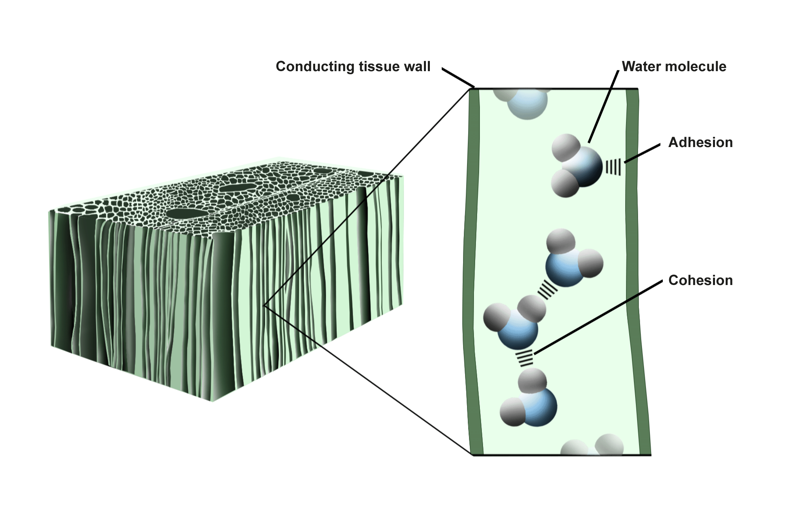
In addition to transpirational pull, the movement of water through the plant is facilitated by cohesion[term: cohesion – The ability of molecules to stick together through chemical interactions. For instance, the cohesion of water enables it to travel up the stem of a plant.] and adhesion[term: adhesion – The ability of molecules to adhere to surfaces through chemical interactions. For example, water adheres to the walls of vascular cells of plants through adhesion.], as well as root pressure[term: root pressure – Plant tissues that transport substances within the plant. The xylem transports water to the leaves and the phloem transports the products of photosynthesis.]. Because water molecules are polar[term: polarity – A property of a molecule that refers to the uneven distribution of electrons among its atoms. For instance, in a water molecule, the oxygen atom attracts electrons more strongly than the hydrogen atoms, resulting in a negative charge on the oxygen side of the molecule.], they form relatively strong hydrogen bonds with one another. This phenomenon is called cohesion, and is easily observed when water forms well-defined droplets. When one water molecule moves, it pulls other water molecules along with it as a result of cohesion. Through adhesion, water molecules adhere to the walls of the vascular tissue.
In addition to water, the pili of the plant's roots absorb various nutrients from their surroundings. During this process, water moves into the vascular cells of the root through osmosis[term: osmosis – Water diffusion. Water moves through a semipermeable membrane towards areas where the concentration is lower. For example, in a cell membrane, water moves from a less concentrated solution to a more concentrated one.]. This phenomenon is behind root pressure. The effect of root pressure can be seen in the form of droplets on the edges of plant leaves after nightfall. Even though the leaves do not use water for photosynthesis at night, the root cells continue to pump water upwards from the soil. This causes the excess water to drip out from the leaf's surface. This water is not dew, but liquid seeping out of the leaf due to root pressure.
The force contribution of adhesion, cohesion and root pressure in transporting water is less significant than that of transpirational pull. This is particularly evident in small plants, such as strawberries. In the stems of large plants, such as trees, water is primarily transported by transpiration pull.
Animal cells and tissues
Like plant cells, animal cells join together to form tissues. These tissues then connect with one another to form organs that perform different functions. Organs that perform similar or connected functions form organ systems. For example, the digestive system is responsible for breaking down and absorbing food. Unlike plant cells, most animal cells are highly specialised and are unable to transform into other cell types.
The types of tissue in animals include epithelial or surface tissue, connective and supporting tissue, muscle tissue, and nerve tissue. Not all animals possess all of these tissue types. For example, the most primitive animals may lack nervous tissue.
The function of epithelial tissue[term: epithelial tissue – Tissue formed by cells that line the surface of animals. This epithelium separates the body from its environment. It also protects and insulates the individual. Examples of epithelium include the skin, the inner surface of the intestines and the glands.] is to act as an interface between the animal and its environment. It protects the animal’s organs and organ systems, regulates the absorption and elimination of substances, produces substances and acts as a sensory organ. For example, the human skin provides mechanical protection for the body, prevents microbes from entering it, and reduces fluid loss.
Connective or supporting tissue[term: connective or supporting tissue – Tissue composed of animal cells that supports the body and connects organs to one another. Examples include bone, cartilage, blood and fat.] connects organs to one another and supports and protects the body. This tissue is held together by the extracellular matrix, which is secreted by the surrounding cells and gives the tissue its supporting and connecting properties. Different types of connective tissue also include adipose tissue, cartilage, bone and blood.
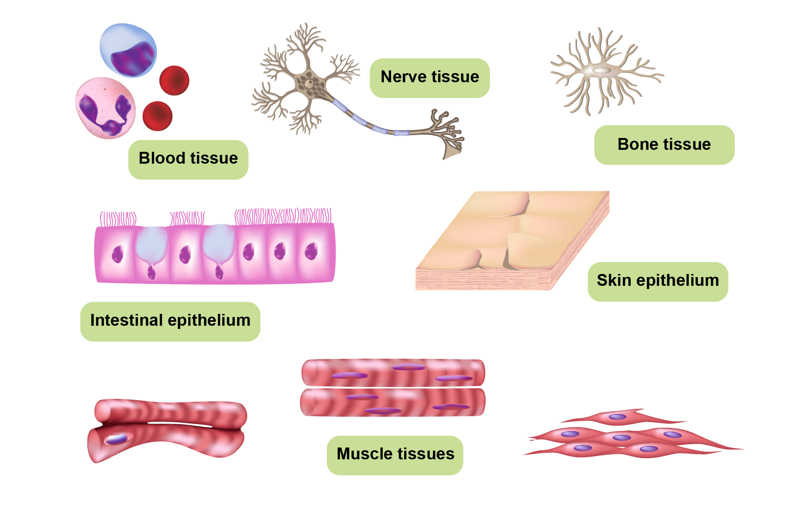
Muscle tissue[term: muscle tissue – A type of animal tissue that consists of contractile cells. Muscle tissue can be categorised into three main types: skeletal, cardiac and smooth muscle tissue.] consists of contractile muscle cells and is responsible for generating bodily movements. There are three main types of muscle tissue: skeletal, cardiac and smooth muscle tissue.
The function of nerve tissue[term: nerve tissue – The part of the body responsible for communication and the regulation of other bodily functions. It consists of nerve cells (neurons) and supporting cells (glial cells).] is to receive, transmit and process information from an animal's environment. This tissue consists of nerve cells, or neurons, as well as supporting cells known as glial cells.
The body of an animal needs all types of tissue in order to function. For example, the circulatory system contains all of the aforementioned tissue types. The innermost layer of blood vessels is lined with epithelial tissue (endothelium), which is surrounded by muscle tissue and connective and supportive tissue. While the heart is made up of muscle tissue, nerve tissue is also required to regulate its function and that of the blood vessels.
Summary
- A vascular plant consists of a root and a shoot, the latter of which is divided into a stem and leaves. Each part of the plant contains specialised cells that form tissues with specific functions.
- Plant tissues are divided into meristematic and permanent tissues. Permanent tissues include the parenchymal, epidermal, vascular, supporting and secretory tissue.
- The transport of water through the plant’s vascular tissue is facilitated by transpirational pull, cohesion, adhesion and root pressure.
- The cells of animals also form tissues. Animal tissues include epithelial (or surface) tissue, connective tissue, muscle tissue and nervous tissue. However, all animals do not possess all of these tissue types.