The birth rate is declining in Finland
The population[term: population – People living within a country's borders.] is the foundation of society. This chapter examines this from demographic and statistical perspectives, discussing the challenges that low population growth poses for social policy. According to Statistics Finland, the population of Finland was 5 656 900 in December 2025. While Finland's population is modest compared to other countries, it should be noted that it has increased fivefold over the past 200 years.
A country's population growth[term: population growth – The increase in a country's population over the course of a year.] is influenced by its birth rate, mortality rate and net migration. The birth rate[term: birth rate – The number of live births per 1 000 people in the population during a specific period.] is defined as the number of live births per 1000 inhabitants in a given year. When compared across age groups of women of childbearing age (15–49), the calculated rate is referred to as the total fertility rate. More specifically, this indicates the number of children a woman of childbearing age would give birth to during her lifetime, assuming the birth rate remains at the level of the reference year. The mortality rate[term: mortality rate – The number of deaths occurring per 1 000 people in the country during one year.] is defined as the number of people who died in the country per 1000 inhabitants during the year, while net migration[term: net migration – The difference between the number of people who have moved into the country and the number who have moved out.] is defined as the difference between the number of people who moved into the country and the number who moved out during the year. The statistics include moves that lasted for the entire year.
One of the biggest challenges facing Finnish social policy today is the low birth rate. The birth rate began to decline in Finland in the 1960s, and this trend accelerated further in the 2010s. According to a recent forecast by Statistics Finland, the number of people under the age of 15 in Finland is expected to fall from 832 000 to around 700 000 by 2070. Nevertheless, due to immigration, Finland's total population is projected to increase to 6.5 million during the same period.
Population changes in Finland over example decades
Births | Deaths | Births minus deaths | Population increase | Net migration | Population at the | |
1861–1870 | 616 000 | 576 000 | 40 000 | 22 000 | −18 000 | 1 747 000 |
1891–1900 | 903 000 | 521 000 | 382 000 | 288 000 | −94 000 | 2 656 000 |
1911–1920 | 830 000 | 583 000 | 247 000 | 288 000 | −42 000 | 2 943 000 |
1940–1950 | 926 000 | 518 000 | 408 000 | 334 000 | −74 000 | 4 030 000 |
1961–1970 | 765 000 | 434 000 | 330 000 | 152 000 | −178 000 | 4 446 000 |
2001–2010 | 582 386 | 489 498 | 92 888 | 192 393 | 100 018 | 5 188 008 |
2011–2020 | 547 597 | 530 439 | 17 158 | 132 000 | 141 938 | 5 401 267 |
The following figures illustrate the decline in the birth rate. For instance, 84 864 children were born in Finland in 1955, when the fertility rate was 2.90. By contrast, in 2025, there were only 45 832 births, giving a fertility rate of 1.30. For Finland's population to grow, the fertility rate would need to be at least 2.10. The rapid pace of change over the past decade is evident when we consider that 59 530 children were born in Finland in 2008, with a fertility rate of 1.85.
The decline in the birth rate is linked to the increasing age at which women are having their first child. According to Statistics Finland, the average age was 30.4 years in 2025. This is higher than in 1985 (25.5 years) and 2010 (28 years).
The gradual decline in birth rates and the increasing age at which women become mothers for the first time are long-standing phenomena common to all industrialised countries, although there may be differences between countries, regions and religious groups. Industrialisation and urbanisation have transformed women’s status and family values. Women’s participation in the workforce, coupled with an increase in educational attainment, is delaying the formation of families and childbearing. The use of contraceptives enables family planning, meaning parents can decide how many children they want. However, despite social support, having a new child also means an increase in family expenses.
Without research data, it is too soon to determine why the number of births in Finland declined so sharply during the 2010s. Is this a temporary phenomenon or a lasting trend? Have the attitudes of young women and couples changed permanently, or is it a result of the prolonged economic downturn between 2008 and 2016?
In a report prepared for the Ministry of Social Affairs and Health in 2024, Anna Rotkirch, Research Director at the Family Federation of Finland (Väestöliitto), identified seven possible reasons for the recent decline in the birth rate: 1) limited public knowledge of the importance of fertility age when trying to conceive, 2) increased mental health issues among young adults, 3) an increase in single-person households, 4) an older average age for first-time mothers, 5) a fear of being alone with a child, i.e. weak community ties, 6) a decline in the value placed on parenthood, and 7) the influence of social media and the internet on the attitudes and time management of young adults.
A rapid and dramatic decline in the birth rate was observed in Greece and Spain during the financial and eurozone crises, for example. Young adults who were forced to live with their parents for financial reasons had to postpone starting a family, which naturally impacted birth rates. Cuts to family policy funding also impacted the desire of other young adults to have children.
Prevailing values and attitudes also influence the decision to have children. Some believe that limiting the number of children is justified in a world where humans are already consuming one and a half times the Earth’s food and energy resources, thereby threatening the stability of the atmosphere and biodiversity. However, others want to limit their family size to two children because this is a widely accepted family model that does not significantly compromise the family’s standard of living.
Net migration increases the Finnish population
For the time being, Finland's population is growing due to a decline in mortality rates and, more importantly, positive net migration.
Most deaths reported to the population register are due to natural causes resulting from various illnesses. However, over the past two hundred years, people in Finland have also died as a result of famine, disease and war.
The decline in mortality is due to improvements in healthcare and the standard of living. According to Statistics Finland, life expectancy at birth is now 78.9 years for boys and 84.3 years for girls. Over the past 100 years, life expectancy has increased by around 27 years for boys and around 33 years for girls. Infant mortality[term: infant mortality – The number of deaths among children under one year of age per 1 000 live births.], or the mortality rate of children under one year of age, has also fallen dramatically during the same period. In 2021, only 91 children under one year of age died in Finland, equating to 2.1 children per 1000 live births.
In addition to the decline in mortality rates, net migration has also contributed to Finland’s population growth. In recent decades, more people have moved to Finland than have left the country. For instance, according to Statistics Finland, the country's population increased by 39 081 in 2023, despite 15 020 more deaths than births that year. This growth was due to net immigration of 54 101 people that year.
Demographic and economic dependency ratios
For the economy and the welfare state to fulfil their roles, the population must grow or renew itself. Businesses need a workforce, and the public sector needs both a workforce and taxpayers. Typically, a country's population increases when the birth rate exceeds the death rate, but in Finland, this growth is primarily driven by immigration.
Statisticians have developed three indicators to track population growth: the population pyramid and the concepts of demographic[term: demographic dependency ratio – The ratio of the working-age population (ages 16–65) to children and the elderly.] and economic dependency ratios[term: economic dependency ratio – The ratio of the economically dependent population (children, the elderly, people on disability, the unemployed, and students) to the economically active (working) population.].
A population pyramid[term: population pyramid – A diagram in which a country's population is divided into age groups (typically 5-year intervals) based on gender and age, illustrating the population structure.] illustrates the structure of a country’s population at a given point in time. The graph depicts the population's age and gender distribution. As it includes figures for the entire population, the graph provides information on population trends and future developments.
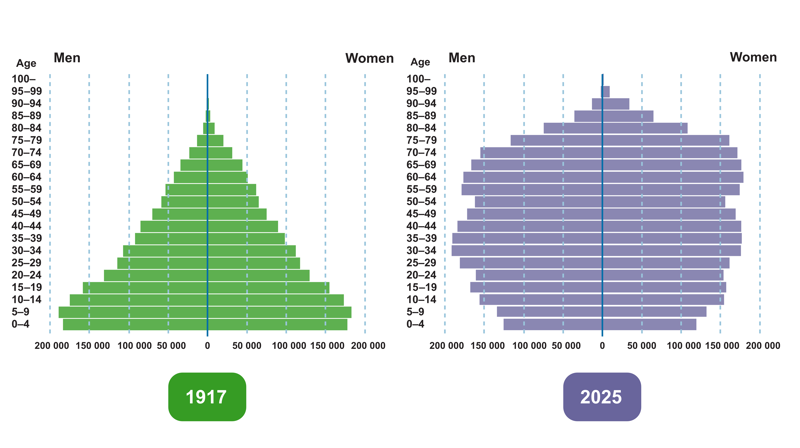
The ideal population pyramid has a large base created by a high birth rate. The middle section of the pyramid, which is slightly narrower, consists of the working-age population. The apex of the pyramid consists of the retired population. The ideal population pyramid illustrates the importance of birth rates for the overall care of the population. Due to declining birth rates and an ageing population, Finland’s population pyramid has not resembled the ideal model for some time.
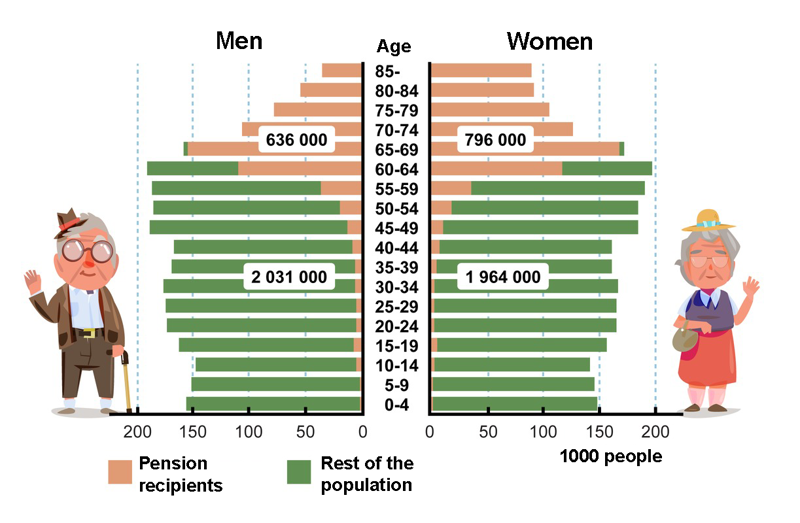
In particular, there was previously great concern about the aging of the baby boomer generation. This group comprises the large number of people born in the years that followed the Second World War (1945–1950). There were fears about what would happen when these generations retired: who would do their work, who would pay their pensions, and who would care for them. Even the last of the baby boomers have now retired, and at least for the time being, the feared collapse or crisis has not materialized—perhaps with the exception of elder care.
In addition to the age pyramid, the concepts of demographic and economic dependency ratios have been developed to inform social decision-making. The demographic dependency ratio is the ratio of the non-working-age population (children and pensioners) to the working-age population. Internationally, it has been agreed that the lower age limit for the working-age population is 15 years, with 65 years being the upper age limit. If a country's age structure is sound — that is, if its population distribution resembles a pyramid, or if the number of newborns remains at the same level as the number of working-age people — the country will be able to support its population in the future.
However, the demographic dependency ratio does not tell the whole story about a country’s demographic carrying capacity. Some people that belong to the working-age population are unemployed, some are students and some are unable to work due to illness. Therefore, only a portion of the working-age population supports the non-working-age population. This situation is described by the concept of the economic dependency ratio.
Finland's demographic challenges stem from its weak demographic and economic dependency ratios. According to Statistics Finland, the demographic dependency ratio was 62 children and pensioners per 100 working-age people in 2024. The same source reports that the economic dependency ratio was 132 non-working people (including children, pensioners, students, the unemployed and those unable to work) per 100 working-age people in regular paid employment in 2024.
How could the dependency ratios be improved?
In the coming years, a key task for social policy in Finland will be to address the demographic and economic dependency ratio. To balance the national budget and maintain the welfare state, the Finnish economy will continue to require a working-age population. Against this backdrop, it is understandable that raising Finland’s employment rate[term: employment rate – The proportion of the total working-age population (aged 15–65) who are employed.] has remained the central goal of the economic policies of recent Finnish governments. The employment rate is defined as the proportion of employed people in the total working-age population (aged 15–64). The previous government aimed to raise it to 75 per cent of the labour force. Orpo’s government has an even more ambitious goal: by 2031, the employment rate should rise to 80 per cent of the labour force. According to Statistics Finland, the employment rate in Finland in February 2024 was 72.1 per cent of the labour force (aged 15–64).

The quickest way to improve Finland’s demographic and economic dependency ratio would be to increase the number of foreign workers of working age in the country. This is what the Confederation of Finnish Industries (EK), a business interest group, has demanded of the government. One could cynically and unethically argue that this would be the cheapest way for Finland to solve its future labour shortage, given the sufficient global supply of young people of working age who have already been raised and educated. The previous government stated in its programme that “work-based immigration of skilled labour from outside Europe will be increased”. For political reasons, no such statement can be found in the current Government Programme, but all the governing parties except the Finns Party are in principle supportive of the idea.
Conversely, one argument against the plan is that asylum seekers already living in Finland have a lower employment rate than the native population. The reasons for their low employment rate include insufficient Finnish language skills, weak professional competence and the attitudes of employers and wider society. The experiences of Sweden and Germany in building a multicultural society also frighten many people, even though they inspire others. Conversely, advocates of labour migration wish to distinguish between labour migration and humanitarian migration. In other words, the professional skills of immigrants would be verified before they immigrate. Opponents, however, fear that labour migration will increase unemployment among the native population and contribute to the emergence of low-wage sectors.
One way to improve Finland’s dependency ratio would be to increase the number of children born in the country. To achieve this, the government would need to implement family policy measures that encourage parents to have more children. These measures could include increased child benefits, extended family leave and support for women returning to work after childbirth. According to a Finnish study, increasing home care and parental allowances increases parents’ desire to have more children. However, a similar study in the United Kingdom did not observe this effect. All the above measures would increase government spending. Only time will tell if there are political will and financial resources to do so.
Family policy measures and gender equality goals appear to be intertwined. For instance, Marin’s government introduced a gender-equal family leave reform, whereby parental benefits and leave were divided equally between parents. The promotion of gender equality has generally been the guiding principle of family policy. Public debate has focused on providing free early childhood education, for example, as this would support families financially and encourage women to return to work.
Longer careers as a solution
Recent governments have sought to improve the economic dependency ratio and raise the employment rate. A key objective has been to extend workers’ careers.
The aim is for employees to join the workforce at a younger age and remain in employment for longer. Efforts to achieve the former have focused on speeding up the process of securing a place in higher education and shortening the duration of studies. However, both goals have only been achieved to a limited extent so far. Although an increasing number of students are financing their studies with government-backed loans, many still choose to work during term time. This naturally delays their graduation. Furthermore, only around 30 per cent of recent upper secondary school graduates secure a place at a higher education institution (universities and universities of applied sciences) in the same year. Under the new University Act, which came into effect in 2016, higher education institutions must reserve a certain number of places in the joint application process for first-time applicants.
Additionally, in 2020, higher education institutions transitioned to a student selection process that places greater emphasis on the matriculation exam. Although the 2025 reform of university entrance exams partially reduced the importance of the matriculation exam in the selection process, the goal of facilitating a rapid transition to higher education after upper secondary school has remained. It remains to be seen whether these reforms will accelerate students’ transition into the workforce.
Efforts have been made to extend working careers by raising the retirement age and paying supplementary pensions for additional years of service. While the new Employment Pensions Act, which took effect in 2017, both raises the retirement age and reduces pension accrual, a long career and continued work after reaching retirement age will still increase the amount of the pension.
Currently, a life expectancy factor[term: life expectancy factor – A factor applied to employment pensions that reduces the pensions of those born after 1947.] is used to reduce the pension of those born after 1947. However, the impact of this factor can be mitigated by working for longer.
Demanding work life
Efforts by previous governments to raise the retirement age have also been criticised. Usually, people do not retire early because they are lazy; they do so because they can no longer cope with their work. This may be due to the physical demands of the job, its hectic pace, the atmosphere in the workplace, or poor management. Mental health issues, cardiovascular diseases and musculoskeletal disorders are the leading causes of early retirement due to disability. Additionally, older employees used to be at risk of redundancy simply because of their age, as someone over 63 who was made redundant was entitled to unemployment benefits until retirement. This entitlement was abolished by a decision of the Finnish Parliament in 2020. In short, Finns' allegedly low retirement age (62.2 years) is not necessarily due to low work motivation or a permissive pension system, but rather to working life structures.
The social policy debate, which focuses entirely on changing demographic and economic dependency ratios, has also been criticised for exaggerating the situation. For example, it fails to acknowledge that the current situation is not new. Historically, the working-age population has had to support a much larger proportion of people under the age of 15 than over 65. If a significantly poorer and less efficient national economy was able to support the entire population, why can't a richer, more efficient one do the same now? Furthermore, it seems strange to talk about a labour shortage when economic globalisation and the associated rise in labour productivity are threatening to permanently exclude part of the workforce from the labour market.
On the other hand, the economic dependency ratio is linked to economic fluctuations. It weakens during a recession and improves during an economic upturn. Furthermore, upon closer inspection, problems relating to population structure and the dependency ratio are regional in nature. The issue is that municipalities in regions with a “healthy” population structure and “good” dependency ratios are less willing than before to fund the activities and livelihoods of municipalities and residents in weaker regions.