Authors
Jarkko Lampiselkä & Ari MyllyviitaExercises kit’s authors
Jarkko Lampiselkä & Ari MyllyviitaPublisher
Included in packages
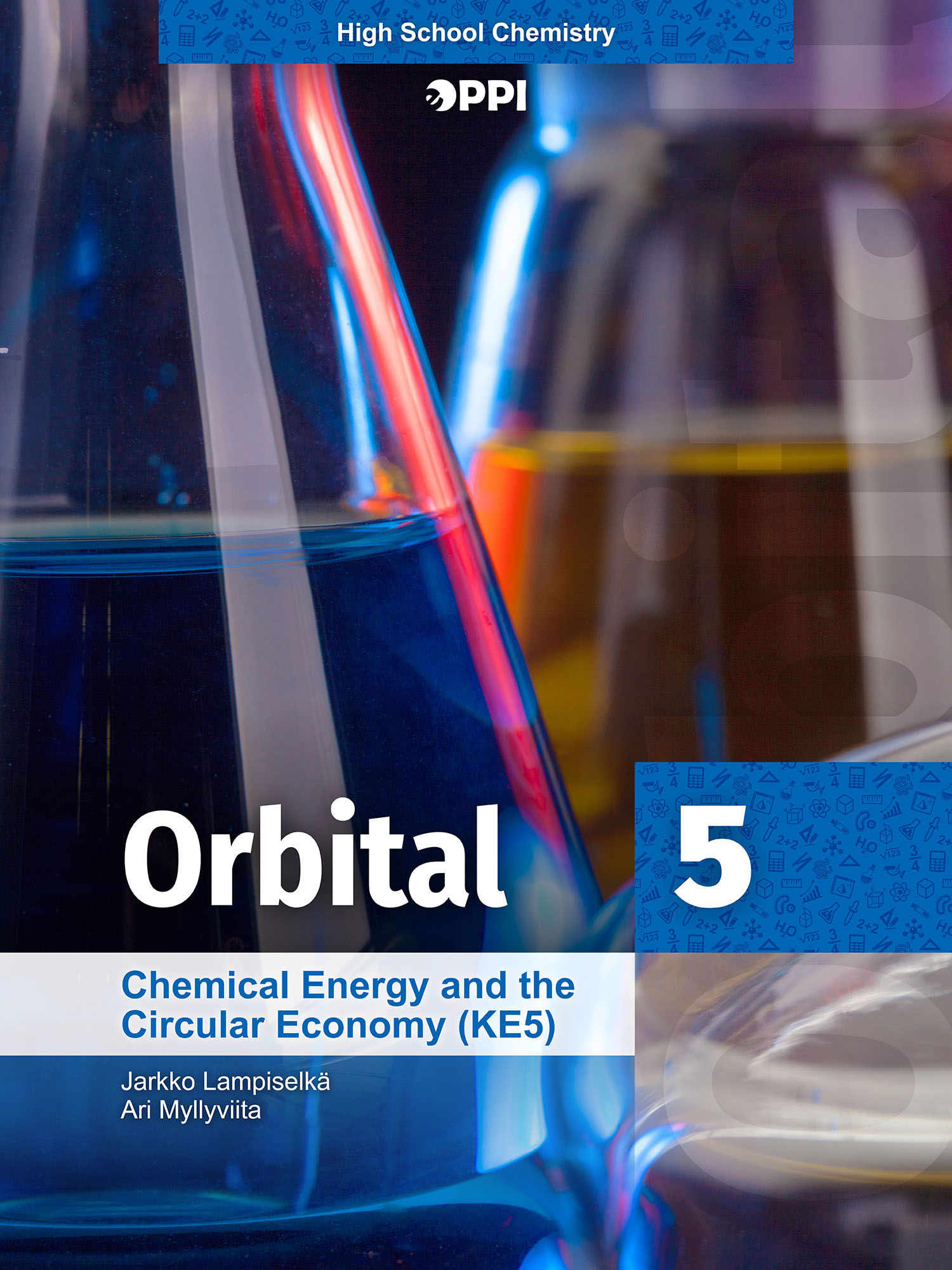
The Orbital 5 learning material covers the fifth module of upper secondary school physics, "Chemical energy and the circular economy".
The Orbital series is a modern learning material for chemistry that encourages the student to think about, investigate, and understand chemistry. The text is designed to captivate the reader. The examples feature important chemical processes and discoveries that are familiar from everyday life. In addition to traditional text explanations, animations, videos and 3D models have also been used to visualise processes.
The tasks follow the new digital final exam model, progressing from tasks that test memory skills through concepts to practical and more challenging tasks.
Models and visualisation play a key role in learning chemistry.
Chemistry is learnt by visualising your own thoughts and by presenting them to other students. Discussions help to develop our own thought processes. Modelling uses simulations, but you will also need a pen and paper. Students can freely choose between visualisation methods.
Chemistry is also learnt together. Learning is social in nature, so the material encourages students to work together.
1. To the reader
Lead |
Chapter |
|---|---|
| 1.1. | Foreword |
2. Energy changes in a chemical reaction
Lead |
Chapter |
|---|---|
| 2.1. |
Reactions, energy and the conservation of energy
Free chapter! |
| 2.2. | Enthalpy, heat of reaction, formation and solution |
| 2.3. | Hess’s Law |
| 2.4. | Bond energy |
| 2.5. | Activation energy |
| 2.6. | Reaction series |
| 2.7. | Additional information: Entropy and Gibbs energy |
| 2.8. | Experimentation |
3. Geochemistry
Lead |
Chapter |
|---|---|
| 3.1. | Metals in nature – Minerals |
| 3.2. | Additional information: Minerals, rock types and jewels |
| 3.3. | Mineral extraction industry |
| 3.4. | Metallurgy |
| 3.5. | Metal mining and enrichment |
| 3.6. | Iron manufacturing |
| 3.7. | Copper manufacturing |
| 3.8. | Aluminium manufacturing |
| 3.9. | Silver manufacturing |
4. Metals
Lead |
Chapter |
|---|---|
| 4.1. | The general properties of metals |
| 4.2. | Metal mixtures (alloys) |
| 4.3. | Alkali metals |
| 4.4. | Alkaline earth metals |
| 4.5. | Boron group metals |
| 4.6. | Carbon group metals |
| 4.7. | Transition group metals |
| 4.8. | Additional information: Hydrogen and hydrogen compounds |
| 4.9. | Experimentation |
5. Oxidation and reduction
6. Electrochemistry
Lead |
Chapter |
|---|---|
| 6.1. | Metal nobility scale |
| 6.2. | Electrochemical cell |
| 6.3. | Cell notation |
| 6.4. | Standard potential |
| 6.5. | Electrolysis |
| 6.6. | Chemical cell applications: Single-use and rechargeable batteries |
| 6.7. | Corrosion and corrosion prevention |
| 6.8. | Experimentation |
7. Chemical technology
Lead |
Chapter |
|---|---|
| 7.1. | The chemistry of construction |
| 7.2. | From stone to smart materials |
| 7.3. | Nanotechnology |
| 7.4. | The chemical industry |
8. Chemistry research
Lead |
Chapter |
|---|---|
| 8.1. | The study of chemistry |
| 8.2. | Chemistry research |
| 8.3. | Astrochemistry |
9. The importance of chemistry in terms of energy solutions and the environment
Lead |
Chapter |
|---|---|
| 9.1. | Energy production |
| 9.2. | Energy storage |
| 9.3. | Chemistry in the living environment |
| 9.4. | Circular economy |
10. Extras
Lead |
Chapter |
|---|---|
| 10.1. | For the teacher |
-
The study kit contains 53 chapters and 87 exercises of which 16 are in the chapters and 71 in the exercise stack.
-
Authors
Jarkko Lampiselkä & Ari Myllyviita -
Exercises kit’s authors
Jarkko Lampiselkä & Ari Myllyviita -
Subject
Chemistry, natural sciences -
Grade
High school -
Course
KE5 Chemical energy and the circular economy -
Kit's language
English -
Publisher
e-Oppi Oy -
Included in packages